


Blog Archives

NCRPC Announces Staffing Updates

Organization Sees Leadership, Department Role Updates

The NCRPC is pleased to officially announce several staff role updates that have taken place over the past year.

“When I was appointed Executive Director in May, my long-term vision was to create an organization leadership team, and we have done just that by defining new roles for Keegan Bailey and Pepper Roberg,” said Deb Ohlde, NCRPC Executive Director.

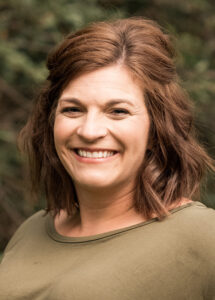
Keegan Bailey has been named Assistant Director. In this role, she supports the Executive Director and other department leaders, focusing on program delivery and project implementation. Bailey has been with the NCRPC since 2015 and will continue to serve as Housing Director, leading the organization’s housing programs and efforts to address regional housing needs.

Pepper Roberg has been named Director of Operations and Personnel. In this senior management role, she focuses on internal operations, physical assets, and financial management. Roberg joined the NCRPC in 2004 and has served as Office Manager since 2008. She continues to oversee office accounting, general administration, and personnel functions.

“Having Keegan and Pepper in these roles helps us benefit from multiple perspectives,” Ohlde said. “Our decisions are stronger when we work together.”

The Weatherization Assistance Program has transitioned to a collaborative management model, appointing Dell Gier as Technical Supervisor and Amanda Augustine as Administrative Supervisor to co-lead the program. Augustine, who first joined the NCRPC in 2014, brings 10 years of program experience to her new role. Gier has worked as a Housing Inspector since joining the NCRPC in 2002.

Other recent position changes include the naming of Kristina Harrison as Homeland Security Coordinator and Chelsea Smith as Administrative Manager. Harrison, who joined the NCRPC in 2024, oversees fiscal agent responsibilities and collaborates with project managers from each of six regional homeland security councils. Smith, who has been with the organization since 2022, provides in-house technical support and manages accounts receivable for the NCRPC affiliate, NCKCN.

Additionally, in 2024, Brett Beck was named Managing Technician for NCKCN and Lori Thielen was named Communications Director, recognizing their roles and long-time service to the organization. Beck has been a full-time employee since April 2006, and Thielen first joined the NCRPC in 2004.

“The organization is fortunate to have dedicated staff who are passionate about rural Kansas and helping communities achieve their goals,” Ohlde said. “We have a large amount of experience on our staff and that allows us to provide dependable and professional service to the region.”

This article appeared in the December 2025 NCRPC Newsletter.


Local Business Opportunity Attracts Couple to Concordia

NCRPC Business Finance Program Assists in Business Purchase Project

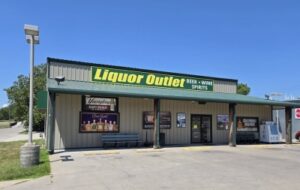
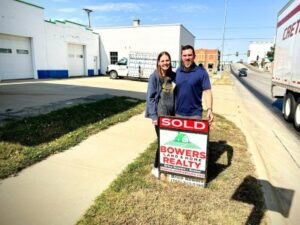
Samantha Parker and her husband, Cameron Morris, along with Tim and Carrie Parker, are the new owners of the Liquor Outlet, located in Concordia, Kansas, along US Highway 81. (Courtesy Photo)

The opportunity to purchase a local business in Concordia, Kansas, has made moving back home a reality for Samantha Parker and her husband, Cameron Morris. In July, they acquired Liquor Outlet, which first opened its doors in March 2001.

Located at 1250 Lincoln Street in Concordia, Liquor Outlet offers a wide selection of beer, wine, and spirits and is open daily. Its primary customer base includes residents of Concordia and Cloud County, as well as travelers along U.S. Highway 81.

Samantha and Cameron recently relocated from Aurora, Colorado, to Samantha’s hometown of Concordia to purchase the business along with her parents, Tim and Carrie Parker. The Parkers previously owned the Taco John’s franchise in Concordia.

Samantha Parker graduated from Concordia High School and Washburn University. She has previous experience working as an Occupational Therapist Assistant. Cameron Morris graduated from Goodland High School and has several years of experience managing liquor stores in both Colorado and Kansas. He manages the day-to-day operations of the business, with support from Samantha and her parents.

“We were excited about the chance to move back and be closer to family and friends while operating a local business,” said Samantha.

The business purchase project was made possible through investments from the owners, assistance from The Citizens National Bank in Concordia, and the NCRPC Revolving Loan Fund Program.

To learn more about the financing program used, contact Debra Peters, NCRPC Business Finance Director. To learn more about the business, visit them on Facebook.

This article appeared in the December 2025 NCRPC Newsletter.


Meet the New Executive Director

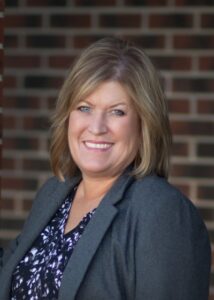
Debra Carlson Ohlde

The North Central Regional Planning Commission (NCRPC) Board of Directors has appointed Debra Carlson Ohlde as its new Executive Director, effective May 1. Read the full news release.

Ohlde is no stranger to the North Central Regional Planning Commission.
She initially joined the staff in 1994 and served in various roles, culminating in the position of Assistant Director, through 2016. After that, Deb stayed connected to community development while operating her consulting company, NEW Heartland Freelance. She also served as the Director of Grower Services for Kansas Corn before rejoining the NCRPC in 2022. She holds a Bachelor of Science degree in Agricultural Economics and a Master’s degree in Public Administration from Kansas State University. Deb and her husband, Tim, are long-time residents of Clyde.

Q&A with the NCRPC Executive Director: Community, Leadership, and the Future of Rural Kansas

For someone unfamiliar with NCRPC or its services, what would you tell them?

Our strength comes from a staff that lives in and loves the region. We understand our member cities and counties, and that impacts how we provide services. We are invested in the region so we strive to provide high quality service and doing so with integrity underpins what we do.”

What excites you most about the future of the NCRPC?

There is always opportunity for communities, businesses and non-profits in rural areas. I’m amazed at the number of young families returning who are choosing this lifestyle and already engaging in community activities and volunteering. We are in such great hands. The NCRPC has the chance to be a key player in solving the challenges we do face and supporting the next generation’s great ideas.

Do you have any advice for communities or businesses in the region or for others working in the field of community development?

Dream big, but validate your idea. I really love the book, “Who Owns The Ice House.”  It captures an approach to entrepreneurship that I think works for businesses and communities. In summary, you look to solve a problem, experiment with your solution on a small scale and then just keep growing and improving. People will support/pay for things that are done well. We see impressive projects and business transformations all the time in the region.

What is a leadership lesson you’ve learned that was impactful?

I admire my husband’s approach to life and his career. He always does ALL the research and has a strong knowledge base on any subject he is working on. He is also great at studying all the details. I tend to be bigger picture focused so I appreciate the balance of the detail person. He also represents servant leadership so well. He works very hard, behind the scenes and prefers to deflect the credit to others.

If you weren’t in this career, what would you be doing?

I thought very hard about going to law school. Once in awhile I wish I would have, but I think I would have been most interested in being in a court room and that doesn’t actually happen that much. I also really loved my accounting classes at KSU. But I don’t think I would have enjoyed doing that type of work all the time. A little bit here and there is enough.

In your spare time, what do you enjoy doing the most?

I have always enjoyed reading and still do. I rarely read fiction; it’s usually something self-help, biographical, or work-related. Podcasts are also wonderful because I do drive a fair amount and enjoy walking outside and I like to listen to them rather than music. Over the years, I have enjoyed the different volunteer things I have done – teaching Sunday School, being a 4-H leader, coaching, etc. I can honestly say that I enjoyed my 12 years on our local Board of Education. It is so important to have strong schools in our small towns.

This article appeared in the Quarter 2 2025 NCRPC Newsletter.


Initiative Helps Homeowners Complete Rehabilitation Projects

Housing Demolition Funding Still Available in Several Kansas Counties

Financial assistance provided through the third year of the NCRPC Housing Initiative enabled the completion of 90 housing rehabilitation projects across six Kansas counties: Logan, Osborne, Ottawa, Phillips, Rawlins, and Sherman.

The NCRPC administered the initiative through a partnership with the Dane G. Hansen Foundation of Logan, Kansas. The initiative offered two pilot programs: a Moderate-Income Housing Rehabilitation Pilot Program and a Demolition Pilot Program.

The Moderate Income Housing Rehabilitation Pilot Program provided reimbursement grants of up to $10,000 to homeowners to complete housing upgrades. The most common upgrades completed with grant assistance were new HVAC systems, windows, and flooring.

“This year, we again saw a huge demand for the rehabilitation program,” said Keegan Bailey, NCRPC Housing Director. “It is making an impact in our rural communities by assisting homeowners that meet moderate-income requirements, which is a group that is not often served by other funding programs.”

Although funds for rehabilitation have been spent for all six counties, there is still funding available for the demolition of dilapidated residential structures in these locations through the Demolition Pilot Program. Property owners may apply for reimbursement grants of up to $5,000 per property for the removal and cleanup of residential structures, such as houses, garages, and sheds. There are no income restrictions to be eligible to apply.

“The decision to remove a residential structure is usually not an easy one to make, but it can be necessary if a property is impacting the health and safety of neighboring residents,” said Bailey. “Doing so may also open up an empty lot for new construction.”

As of July 2, the following slots were available for the demolition pilot program: Logan County (9), Osborne County (2), Ottawa County (2), Phillips County (4), Rawlins County (2), and Sherman County (5). The program will end on March 31, 2026 or when funds are expended.

“We are grateful for the continued support of the Dane G. Hansen Foundation in helping to make these programs possible through the NCRPC Housing Initiative,” said Bailey.

Similar pilot programs have also been completed in Cheyenne, Cloud, Decatur, Gove, Graham, Jewell, Lincoln, Mitchell, Republic, Rooks, Russell, and Smith counties.

For the most up-to-date information on funding and to apply for the Demolition Pilot Program funding currently available in Logan, Osborne, Ottawa, Phillips, Rawlins, and Sherman Counties, please visit www.ncrpc.org/housinginitiative.

This article appeared in the Quarter 2 2025 NCRPC Newsletter.


Energy Assessments, Grant Help Available for Eligible Entities

Helping to reduce energy costs for rural small businesses and agricultural producers is one of the goals of the staff at the Kansas Energy Program, housed within the K-State Engineering Extension Department.

The program provides free energy assessments to eligible small businesses, agricultural producers, and non-profit entities. It also provides assistance with applying for USDA Rural Energy for America Program (REAP) grants to agricultural producers or rural small businesses. Applications for the REAP program are anticipated to reopen on October 1.

The Kansas Energy Program assists with the REAP grants, which fall into two main categories: renewable energy systems and energy efficiency improvements. While planning can take time, support is available.

“Depending on the project and its complexity, we can usually come out and conduct an on-site energy assessment,” said Ryan Hamel, Energy Program Specialist with Kansas State University Engineering Extension. “For energy efficiency improvements, we look at existing equipment and the proposed new equipment and estimate the savings. It’s important to note that for energy efficiency projects, they must involve replacing an existing system and cannot be for an expansion.”

Funding through the REAP program is provided via reimbursement-based grants of up to 25% of eligible project costs.

“We are happy to provide assistance/guidance with the energy assessments and grants. We try to make the application process as simple as possible,” said Hamel.

To learn more or to get started, visit the Kansas Energy Program.

This article appeared in the Quarter 2 2025 NCRPC Newsletter.


Endowment Fund Grows with Event

New Fund Gets Small Boost, Planning Beginning for Impact

The newly established NCRPC endowment, officially named the Todd Tuttle Fund for Arts and Science, received a small boost through its participation in a one-day giving event held in April.
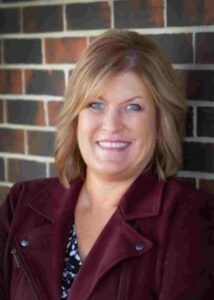

“Even though we are just beginning, donors chose to contribute during this event, and we are grateful for their generosity,” said Todd Tuttle, Technical Consultant to NCKCN, an NCRPC affiliate. “Their confidence in the mission of the fund will help us grow the endowment so we can begin making an impact.”

Donations received during the Give to Grow event were matched dollar for dollar. The event was sponsored by the Solomon Valley Community Foundation.

“We are excited to see this fund grow so that future generations can benefit in the areas of Arts and Science,” said Julia Rabe, Executive Director of the Solomon Valley Community Foundation. “The Foundation is thrilled to partner with Todd Tuttle and NCRPC to achieve their philanthropic goals.”

Learn more about the fund. To learn how to make a donation online, visit the Solomon Valley Community Foundation and look for the “Give Now” button.

This article appeared in the Quarter 2 2025 NCRPC Newsletter.


New Property Allows Concordia Business to Add Product Line

NCRPC Business Finance Program Assists in Building Purchase Project

Lucas and Sarah Chavey have been working on a project to renovate the former Conoco station in Concordia, located along U.S. Highway 81, to accommodate a new product line for Sarah’s business. (Courtesy Photo)

A historic Conoco station located along U.S. Highway 81 in Concordia, Kansas, will soon offer a creative experience for all ages.

Eighty-One Enterprises, LLC, owned by Lucas Chavey, recently purchased the property to remodel it for a new product line for his wife’s business. Sarah Chavey has owned and operated Moody Hue Studio for many years in a rented space in downtown Concordia. Renovations on the new location began in 2025, and Sarah plans to reopen it soon under the new name, The Break Pad, to reflect the expanded offerings.

The business will continue to feature its paint studio while also introducing a newly added plant bar. The plant bar allows customers to design personalized potted plant arrangements to take home and enjoy.

In addition to planting and painting, The Break Pad will also include a private event rental space for group planting and painting as well as other events such as bridal showers, social club gatherings, graduation parties, and committee meetings. The Break Pad is located in the main building of the old station at 137 E. 7th in Concordia. The north building (612 Lincoln) provides office space for the Chavey’s, while the garage area is being rented.

This project, which included the purchase of two commercial buildings and renovation of the space for The Break Pad, was made possible through investments from the owners, assistance from The Citizens National Bank in Concordia, and the NCK Business Down Payment Assistance Loan Program offered by NCRPC.

Learn more about the NCRPC Business Finance program.

Learn more about The Break Pad and its services.

This article appeared in the Quarter 2 2025 NCRPC Newsletter.


NCRPC Appoints Executive Director

The North Central Regional Planning Commission (NCRPC) Board of Directors is pleased to announce that Debra Carlson Ohlde has been appointed as its new Executive Director, effective May 1.

“We are thrilled to have Deb in this top management position at NCRPC,” said Tom Claussen, Chair of the NCRPC Board. “She is extremely qualified and dedicated to North Central Kansas through her involvement in local community activities and her professional career. Deb truly loves this area of the state and will do what is best for the region and the organization.”

NCRPC Executive Director Debra Carlson Ohlde

Deb is a long-time resident of Clyde, Kansas, with many years of experience at NCRPC. She initially joined the North Central Regional Planning Commission, which is based in Beloit, in 1994 and served in various roles, culminating in the position of Assistant Director, through 2016. After that, Deb stayed connected to community development while operating her consulting company, NEW Heartland Freelance. She also served as the Director of Grower Services for Kansas Corn before rejoining the NCRPC in 2022.

“After being with the organization for 22 years, I benefited from the years I spent taking on new types of work and challenges. The skills and experiences from my time away broadened my perspective and expanded my network. However, my heart lies in the community development field and North Central Kansas,” said Ohlde. “Helping communities solve problems and realize dreams has been a rewarding career path. I look forward to supporting our capable staff in this new role as we continue to serve the region.”

Deb holds a Bachelor of Science degree in Agricultural Economics and a Master’s degree in Public Administration from Kansas State University. She has expertise in strategic planning, small group facilitation, and proposal writing/project management within the public and non-profit sectors.

“We look forward to Deb’s leadership and vision as we continue to advance the organization,” said Claussen.

The North Central Regional Planning Commission is a comprehensive planning and development organization serving a 12-county region in North Central Kansas. Several of its programs and services also extend into much of Kansas. 


Home Buyers in Clay, Marshall Counties Benefit from Home Ownership Programs

Programs Now Completed in all NCRPC Service Area Counties

Financial incentives in the form of down payment and closing cost assistance were available to eligible home buyers in Clay and Marshall Counties from May to December 2024. The Pilot Home Ownership Programs in these locations assisted in home purchases totaling over $2.7 million, with the pilot programs contributing $162,500.

The North Central Regional Planning Commission (NCRPC), Beloit, Kansas, administered the programs. Four Rivers Housing Opportunities, Inc., a non-profit managed by the NCRPC, provided funding for the initiative. Local partners who contributed to the Clay County Home Ownership Pilot Program included Clay County, Grow Clay County, and United Bank & Trust. For the Marshall County Home Ownership Pilot Program, additional local contributors included Citizens State Bank of Marysville, First Commerce Bank, First Heritage Bank, Vermillion; First National Bank, Frankfort; Guise-Weber Foundation, Marshall County Partnership for Growth, Marysville Community Foundation, R.L. & Elsa Helvering Trust, State Bank of Bern, Axtell; United Bank & Trust, and Western National Bank, Summerfield.

“We appreciated the partnerships and the local support that made these programs possible,” said NCRPC Housing Director Keegan Bailey. “Strengthening rural housing is a key to success for our communities, and this program was one tool to help achieve that.”

First-time home buyers represented 48% of the program participants. The program provided buyers with critical financial resources amid rising material and housing costs.

“The feedback from participants indicated that the down payment assistance was a significant factor in helping them afford a home, and, in some cases, allowed them to make upgrades sooner than originally planned,” Bailey said.

The primary motivations for home buyers accessing the pilot program included job factors, moving closer to family and friends, reduced commuting times, and a desire to experience a rural lifestyle or live in a rural community.

Since 2018, pilot home ownership programs have been completed in all 12 counties within the NCRPC primary service area. Collectively, these pilot programs have assisted in the purchase of 162 homes in the region with an approximate value of $22.2 million. The results of these pilot programs will inform the development of a permanent regional relocation program, pending funding availability.

This article appeared in the Quarter 1 2025 NCRPC Newsletter.


Empty Homes, Full Potential: Rethinking Vacant Housing

By Keegan Bailey, NCRPC Housing Director

Keegan Bailey

Rural and urban communities have one commonality within their housing stock: vacant properties.

There are many different reasons why structures can be vacant. Vacancies can occur due to foreclosures, inheritance or probate court, vacation-hunting or secondary homes, extensive work needed on the home, and simply beyond useful life. Why is this important? Frankly, each scenario takes away housing from the housing stock.

The longer a house is left vacant, the more probable it is for repairs to go unnoticed and the deterioration of the home to occur. Vacation, hunting, or secondary homes are still paying property taxes and bringing in some revenue a few months out of the year. But for seven to nine months, what revenue is being lost in comparison to if someone lived there full time? Is this where cities should begin to have a higher flat utility rate for those homes that are identified as second homes?

Vacant homes also have an increased need for security to avoid vandalism, trespassing, and maintenance. Should cities begin to look into structural integrity inspections, with more emphasis on health and code enforcement? With any new way of addressing housing needs, there could be resistance, criticism, and even an increase in legal/enforcement action. The biggest question that would need to be answered is how can NCRPC begin to help address the vacant housing issues along with the communities that we serve?

Keegan Bailey has been the Housing Director at NCRPC since 2020 and has been with the organization since 2015.

This article appeared in the Quarter 1 2025 NCRPC Newsletter.


Archives